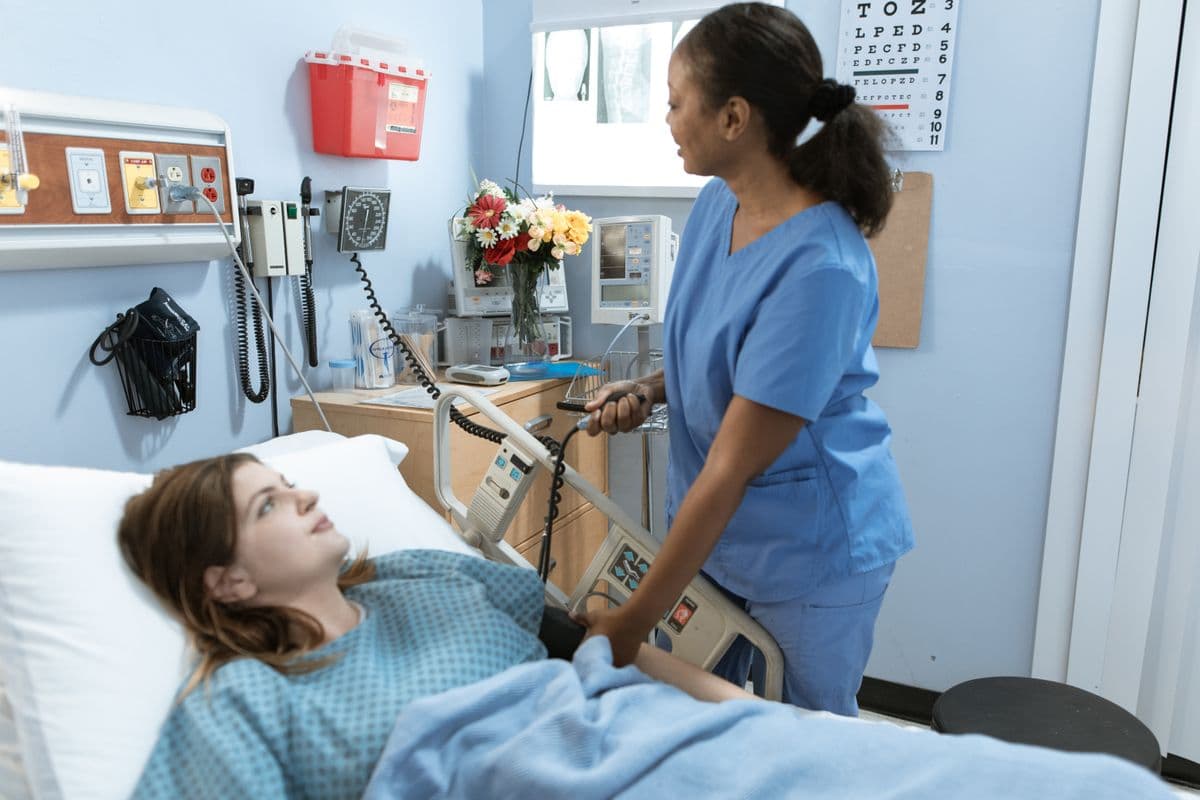
Nurses in municipal hospitals and care homes (run by towns and districts) are paid from a collective pay table. It is called the TVöD (the pay agreement for the public sector). From 1 May 2026, a nurse in pay grade P 7 earns €3,510 to €4,305 gross a month. In P 8 the pay is €3,701 to €4,489, and in P 9 it is €3,992 to €4,662. In hospitals, two extra payments come on top every month: a care allowance of €141.82 and a flat allowance of €25.
Across all employers, the Entgeltatlas (the pay statistics of the Federal Employment Agency) puts the median for full-time nurses at €4,587 a month. It ranges from €4,290 in Saxony to €4,784 in Baden-Württemberg.
Pay table: TVöD Anlage E (Pflegedienst) from 1 May 2026
Gross monthly pay in euros. The normal working time is 38.5 hours a week on average. For employers in the Baden-Württemberg municipal employers' association, it is 39 hours.
- P 7: Who it is for: Nurse with at least three years of training; Step 2: 3,510.30; Step 3: 3,701.21; Step 4: 3,998.33; Step 5: 4,149.59; Step 6: 4,305.40
- P 8: Who it is for: Particularly demanding nursing work, or practice instructor with the required teaching qualification; Step 2: 3,701.21; Step 3: 3,862.80; Step 4: 4,075.58; Step 5: 4,247.92; Step 6: 4,488.98
- P 9: Who it is for: Nurse with completed specialist training (Fachweiterbildung) working in that specialty; Step 2: 3,992.39; Step 3: 4,184.40; Step 4: 4,312.38; Step 5: 4,558.59; Step 6: 4,662.42
These grades have no step 1. New staff start at step 2.
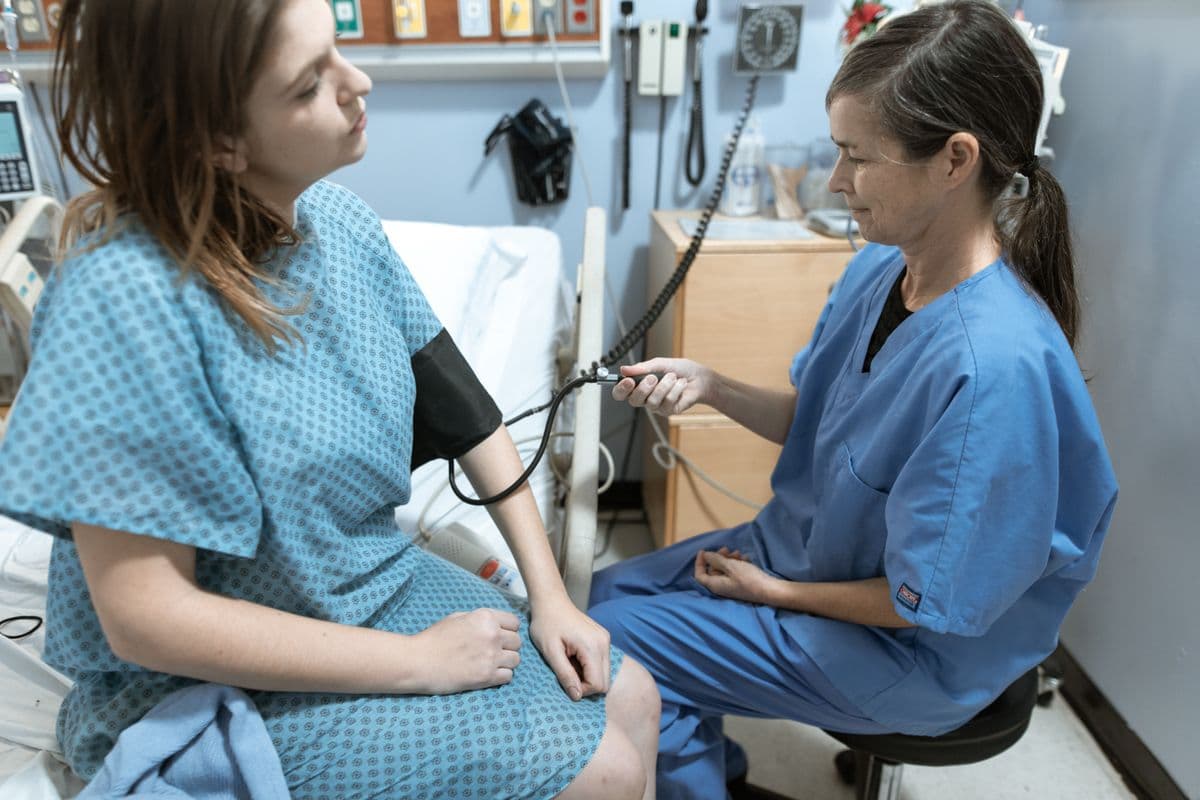
Nurses in municipal hospitals are paid from the TVöD pay table.
How you move up the steps
- You start at step 2. Your employer can count relevant earlier work. This can place you in a higher step.
- P 7 and P 8: step 3 comes after three years in step 2. This rule does not apply to nurses who spend at least half of their working time in certain areas. Examples are dialysis, endoscopy, outpatient and emergency departments, operating theatres and anaesthesia, intensive care, and cardiac catheter labs. The pay agreement lists all of them (see Sources).
- Later steps follow the general TVöD rules. Step 4 comes after three years in step 3. Step 5 comes after four years in step 4, and step 6 after five years in step 5. From step 3 on, moving up also depends on your performance.
Extra pay on top of the table (hospitals, TVöD BT-K)
- Care allowance (Pflegezulage): Amount: €141.82 a month from 1 May 2026
- Flat allowance: Amount: €25 a month (€35 for employers in the Baden-Württemberg municipal employers' association)
- Rotating-shift allowance (Wechselschichtzulage): Amount: €250 a month if you work rotating shifts permanently; otherwise €1.49 an hour (€1.47 in Baden-Württemberg)
The allowance amounts change when general pay rises. The shift allowances change after 31 December 2026. The care allowance changes after 31 March 2027. Extra pay for night, Sunday and holiday work also comes on top. It is set in the general part of the TVöD, which this post does not cover.
What nurses earn across Germany: by federal state
The tariff table above only covers employers that use the TVöD. The Federal Employment Agency's Entgeltatlas shows what full-time nurses earn at every kind of employer. It shows this by federal state, as of 31 December 2025. The group is general nursing (KldB 81302, the official job code). It includes Gesundheits- und Krankenpfleger, Gesundheits- und Kinderkrankenpfleger and Krankenschwester/-pfleger (general and children's nurses). Nationally the median is €4,587 a month. The middle half earn between €4,111 and €5,116.
- Baden-Württemberg: Lower quartile: €4,289; Median: €4,784; Upper quartile: €5,296
- Saarland: Lower quartile: €4,315; Median: €4,768; Upper quartile: €5,271
- Bremen: Lower quartile: €4,200; Median: €4,708; Upper quartile: €5,266
- Hesse: Lower quartile: €4,152; Median: €4,667; Upper quartile: €5,220
- Berlin: Lower quartile: €4,184; Median: €4,655; Upper quartile: €5,252
- Bavaria: Lower quartile: €4,193; Median: €4,632; Upper quartile: €5,172
- Hamburg: Lower quartile: €4,145; Median: €4,615; Upper quartile: €5,117
- North Rhine-Westphalia: Lower quartile: €4,115; Median: €4,600; Upper quartile: €5,135
- Rhineland-Palatinate: Lower quartile: €4,147; Median: €4,599; Upper quartile: €5,132
- Schleswig-Holstein: Lower quartile: €4,067; Median: €4,577; Upper quartile: €5,088
- Lower Saxony: Lower quartile: €4,087; Median: €4,534; Upper quartile: €5,038
- Thuringia: Lower quartile: €3,958; Median: €4,380; Upper quartile: €4,821
- Brandenburg: Lower quartile: €3,933; Median: €4,362; Upper quartile: €4,794
- Saxony-Anhalt: Lower quartile: €3,959; Median: €4,347; Upper quartile: €4,793
- Mecklenburg-Vorpommern: Lower quartile: €3,875; Median: €4,318; Upper quartile: €4,783
- Saxony: Lower quartile: €3,864; Median: €4,290; Upper quartile: €4,738
The highest medians are in Baden-Württemberg (€4,784), Saarland (€4,768) and Bremen (€4,708). The lowest are in Saxony (€4,290), Mecklenburg-Vorpommern (€4,318) and Saxony-Anhalt (€4,347). The five eastern states have medians between €4,290 and €4,380. They are Brandenburg, Mecklenburg-Vorpommern, Saxony, Saxony-Anhalt and Thuringia. All other states are between €4,534 and €4,784.
Large cities
The Entgeltatlas lists eleven large cities. Munich has the highest median of them.
- Munich: Lower quartile: €4,476; Median: €4,994; Upper quartile: €5,536
- Stuttgart: Lower quartile: €4,436; Median: €4,922; Upper quartile: €5,466
- Cologne: Lower quartile: €4,341; Median: €4,847; Upper quartile: €5,430
- Frankfurt am Main: Lower quartile: €4,342; Median: €4,842; Upper quartile: €5,307
- Essen: Lower quartile: €4,246; Median: €4,711; Upper quartile: €5,262
- Düsseldorf: Lower quartile: €4,201; Median: €4,658; Upper quartile: €5,104
- Hanover: Lower quartile: €4,247; Median: €4,619; Upper quartile: €5,118
- Dortmund: Lower quartile: €4,170; Median: €4,609; Upper quartile: €5,056
- Nuremberg: Lower quartile: €4,165; Median: €4,520; Upper quartile: €4,922
- Leipzig: Lower quartile: €4,025; Median: €4,445; Upper quartile: €4,895
- Dresden: Lower quartile: €4,018; Median: €4,369; Upper quartile: €4,831
Specialist and geriatric nurses
- General nursing, all of Germany (KldB 81302): Lower quartile: €4,111; Median: €4,587; Upper quartile: €5,116
- Nurses in specialist areas such as intensive care, anaesthesia and operating theatre (KldB 81313): Lower quartile: €4,379; Median: €5,057; Upper quartile: €5,760
- Geriatric nurses (Altenpfleger, KldB 82102): Lower quartile: €3,983; Median: €4,438; Upper quartile: €4,886
Why are these figures higher than the tariff table? There are two reasons:
- The Entgeltatlas counts all regular and one-off income from the main job, for example allowances and bonuses. It counts pay up to the social insurance contribution ceiling of €8,050 a month.
- It covers nurses at every employer and at every experience level.
The tariff table shows only base pay by pay grade and step. Pay also depends on your employer, your shifts, your specialisation and your experience.
What nurses earn by age group
The Entgeltatlas also splits pay by age group. The table shows full-time nurses in general nursing (KldB 81302) across Germany, at all employers, as of 31 December 2025.
- Under 25: Lower quartile: €3,996; Median: €4,288; Upper quartile: €4,563
- 25 to under 55: Lower quartile: €4,122; Median: €4,605; Upper quartile: €5,118
- 55 and over: Lower quartile: €4,287; Median: €4,931; Upper quartile: €5,495
In general nursing, the median is €4,288 a month under 25. It is €4,605 from 25 to under 55, and €4,931 from 55. The median for the middle group is €317 higher than for the youngest group. For the oldest group it is €643 (15%) higher than for the youngest. Specialist and geriatric nurses show the same pattern. Only 1,037 specialist nurses under 25 are in the data, so that figure rests on a small group.
- Under 25: Specialist nurses, median (KldB 81313): €4,302; Geriatric nurses, median (KldB 82102): €4,086
- 25 to under 55: Specialist nurses, median (KldB 81313): €5,027; Geriatric nurses, median (KldB 82102): €4,441
- 55 and over: Specialist nurses, median (KldB 81313): €5,247; Geriatric nurses, median (KldB 82102): €4,581
Age is only a rough guide to experience. The Entgeltatlas compares different people on one date. It does not follow one nurse's pay over a career. It also does not say why pay differs between age groups. And it cannot show what a nurse earns who has just been recognised in Germany. That depends on the employer, the pay grade and how much earlier work is counted (see "How you move up the steps" above).
Who the TVöD table covers
The table applies to employers that use the TVöD. These are mostly municipal hospitals and care homes. Other employers pay under their own agreements or contracts, so compare any offer with the table. Pay grades below P 7 are for other roles. The allowances above are the hospital rules (BT-K). If you work in a care home, check the allowance amounts in your contract.
All figures are gross monthly pay for a full-time job. Tax and social security are deducted before payment, and your personal circumstances determine the net amount.
Nurse jobs
Hospitals, care homes and home care services employ nurses. Apply for jobs that match the title you hold or are being recognised for: general, children's (paediatric) or geriatric nursing. See jobs for international nurses.
Before you can earn this
You need permission from the state office to use the protected nursing title (Pflegefachfrau or Pflegefachmann). Here is how it works:
- Nursing qualifications for general care from the EU may be recognised automatically.
- Other qualifications are checked one by one.
- If big differences remain, you close them with an adaptation period (supervised work in Germany) or an exam (a knowledge test or an aptitude test).
The federal recognition portal lists German at level B2. How you prove it depends on the state. If you are not a citizen of the EU, the EEA or Switzerland, you also need a residence permit that allows you to work. See how to work as a nurse in Germany. Our free personalised roadmap shows the steps for your country and state.
Get a personal offer for your next step
Tell us where you are on your way to working in Germany. We will get back to you with a personal offer, by WhatsApp or email.
How much does a nurse earn in Germany per month?
Where the TVöD applies, a nurse with at least three years of training (P 7) earns €3,510.30 to €4,305.40 gross a month from 1 May 2026. In hospitals, a care allowance of €141.82 comes on top.
What is the starting salary for a nurse in Germany?
New staff start at step 2 of their pay grade. In P 7 that is €3,510.30 gross a month from 1 May 2026.
Do nurses get extra pay for shift work?
Yes. Under the TVöD hospital rules, nurses who always work rotating shifts get a Wechselschichtzulage (rotating-shift allowance) of €250 a month. Others get €1.49 for each hour of rotating shift work. Extra pay for night, Sunday and holiday work comes on top.
Does a nurse trained abroad earn less?
The table has no separate scale for nurses trained abroad. During the adaptation period, before you have full recognition, you are usually employed and paid as a nursing assistant, a lower pay group. Once you are recognised and employed in a TVöD job, you move to the grade for registered nurses, usually P7 or P8 with more responsibility. Your employer decides how much earlier work counts towards your step.
Which state pays nurses the most?
In the Entgeltatlas, the median for full-time nurses is highest in Baden-Württemberg (€4,784 a month). It is lowest in Saxony (€4,290). These figures are as of 31 December 2025.
How much do nurses earn in Munich?
The median for full-time nurses in Munich is €4,994 a month. The middle half earn between €4,476 and €5,536 (Entgeltatlas, 31 December 2025).
Do nurses earn more as they get older?
In the Entgeltatlas, the median for full-time nurses is €4,288 a month under 25. It is €4,605 from 25 to under 55, and €4,931 from 55 (31 December 2025). Age is only a rough guide to experience, and the data do not show why pay differs.
Is this gross or net?
Gross. Tax and social security are taken off before you are paid.